You've probably heard you're a "visual learner" — but what does that actually mean for how you should study?
And more importantly: if you learn visually, why do schools keep making you read walls of text?
What It Actually Means to Be a Visual Learner
Visual learners process information more effectively when it's presented as images, diagrams, animations, and spatial relationships rather than words.
Research from the Journal of Educational Psychology shows that visual learners retain 40% more information when content is presented visually vs. in text form. But here's the catch: most educational content — textbooks, lecture notes, study guides — is almost entirely text-based.
This is why so many smart students feel like they "just don't get it" in school. It's not that they're not intelligent. It's that they're receiving information in the wrong format.
5 Study Strategies That Actually Work for Visual Learners
1. Convert Text to Visuals Before Studying
Before reading a chapter, convert it into a visual format:
- Mind maps — put the main concept in the center, branch out to subtopics
- Flowcharts — for processes and sequences
- Diagrams — for relationships between concepts
- Timelines — for historical content
The act of converting text to visuals forces you to understand the structure, not just read words.
2. Use Color Coding Systematically
Not just highlighting everything in yellow — strategic color coding:
- Red = definitions and key terms
- Blue = examples
- Green = connections to other concepts
- Yellow = things to review again
When your notes are color-coded, your brain stores them with visual spatial memory — much more durable than rote memorization.
3. Watch Before You Read
For complex topics, find a visual explanation first (video, animation, diagram) before reading the textbook. This gives your brain a "scaffold" to hang the text information on.
After watching, reading the textbook feels like reviewing something you already understand — not decoding something foreign.
4. Draw What You're Learning
You don't have to be an artist. Stick figures are fine. The act of drawing:
- Forces active processing (vs. passive reading)
- Creates spatial memory
- Reveals gaps in understanding (if you can't draw it, you don't understand it)
Try drawing the process of DNA replication, or sketch a coordinate system when studying derivatives. The drawings don't need to be accurate — just the attempt of drawing forces understanding.
5. Use AI-Generated Visual Explanations
This is where modern technology finally catches up with how visual learners actually learn.
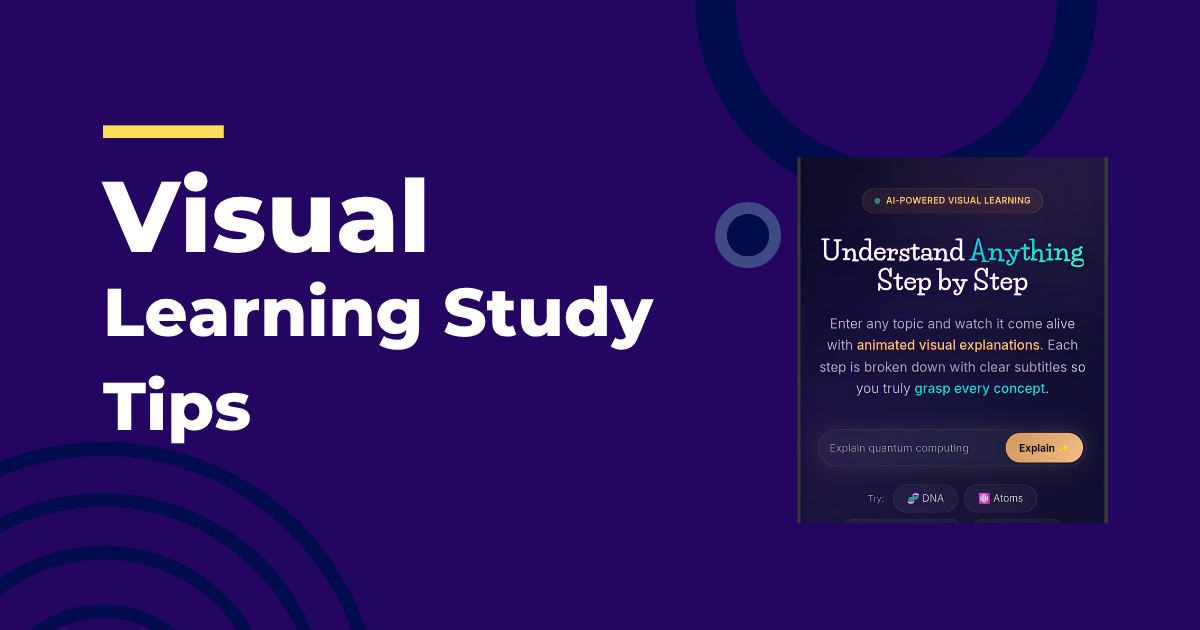
Tools like ExplaNote generate animated visual explanations for any topic you're studying — like having a personal teacher who explains everything with animation instead of words.
For a visual learner studying photosynthesis, quantum mechanics, or calculus:
- Type the topic
- Get a step-by-step animated explanation
- Ask follow-up questions visually
It's the study tool visual learners have always needed but never had.
What Visual Learners Should Avoid
- Passive highlighting — highlighting text doesn't create visual memory
- Re-reading notes — reading the same words again doesn't help visual learners
- Audio-only study — podcasts and audiobooks rarely work well for visual learners
- Long reading sessions without visuals — break every 20 minutes to convert to a visual format
The Core Principle
Visual learners aren't worse learners — they're learners who need a different input format. Once you get information in the right format, retention and understanding improve dramatically.
The goal is to spend less time staring at text and more time engaging with visual representations of the same information.
Generate visual explanations for anything you're studying →
ExplaNote was built specifically for visual learners who are tired of textbooks. Try it free — no credit card required.